
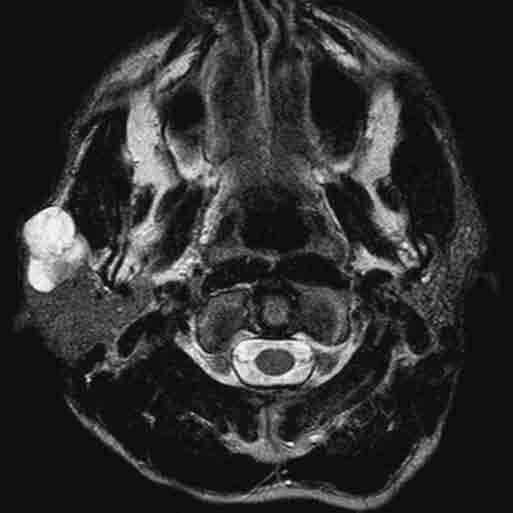
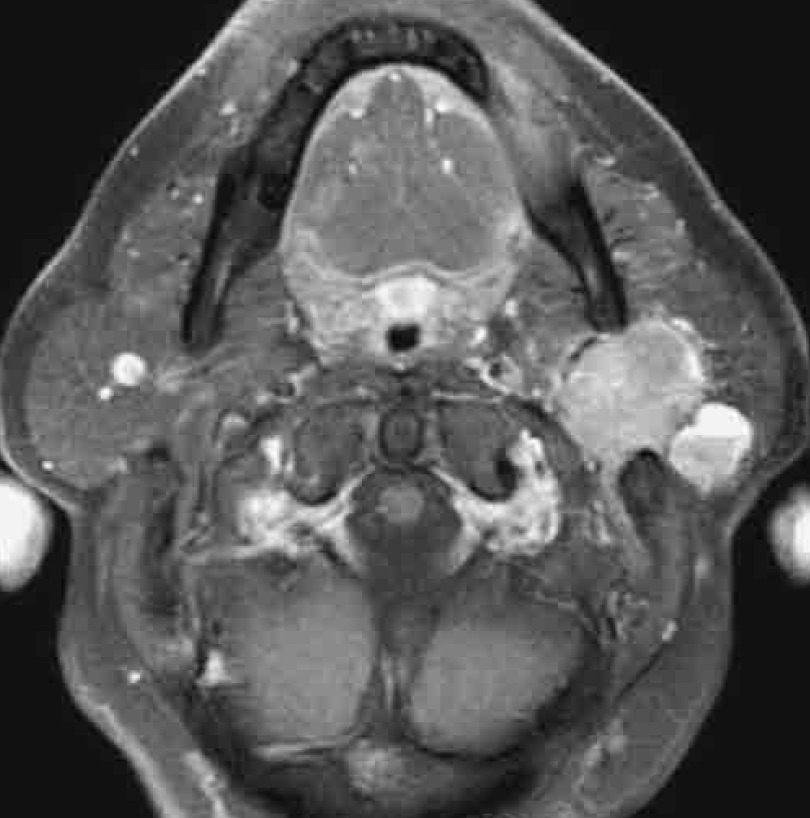
Parotid Tumors

PAROTID TUMORS

Sometimes, the cells of the parotid gland behave abnormally. As a result, they multiply continuously and the parotid gland increases in size. In about 75 to 80% of cases, these masses are benign.

Different types of tumors:

Among benign tumors, the most common histological type is pleomorphic adenoma (or mixed tumor), followed by Warthin’s tumor. Malignant tumors of the parotid gland are rarer and include primary gland cancers, lymphoma, as well as distant metastases originating from other malignant tumors.

Symptoms:

These tumors typically present as a painless, well-defined swelling (a lump) with slow growth. The development of an associated facial paralysis, rapid growth, pain, or fixation (immobility) of the tumor are all signs of a malignant tumor (cancer).

Prognosis:

In the case of benign tumors, the prognosis is generally good; however, it should be noted that malignant transformation can occur in 3 to 4% of pleomorphic adenomas, which also have a tendency to recur after surgery.

The surgeon’s expertise is therefore a key factor in reducing the risk of tumor spread during surgery and thus the risk of recurrence. There is no risk of malignant transformation in Warthin’s tumors. However, these cystic tumors may increase rapidly in size in the event of infection or internal bleeding.

The prognosis of malignant tumors, on the other hand, depends on their histological type, size, and the presence of local, regional, or distant metastases. The main malignant tumors of the parotid gland are adenoid cystic carcinoma and mucoepidermoid carcinoma.

The most important factors in terms of recurrence risk after removal of a malignant tumor are the success of the surgery (meaning complete tumor removal), the type of cancer, and its stage (spread and degree of progression). If the tumor has spread further or is more aggressive, the risk of recurrence after surgery is higher. Failure to achieve complete removal will inevitably lead to recurrence. In addition, it sometimes happens that despite surgery and radiotherapy, some tumors remain active. In summary, everything depends on the nature of the cancer, its spread, its stage of progression, and the success of the surgery.

Clarification:

Except in the case of lymphomas and metastatic tumors, the ideal treatment for benign or malignant parotid tumors is surgical. In the rare cases where the patient’s health condition is a contraindication to surgery, a conservative approach based on clinical and radiological follow-up is recommended. During your consultation, a detailed medical history and a thorough clinical examination will allow Dr. Yousefpour to better assess your condition. He will complete the evaluation by requesting additional tests such as an MRI (magnetic resonance imaging, also called MRN or nuclear magnetic resonance) as well as an ultrasound-guided biopsy (a procedure in which the radiologist performs a biopsy guided by ultrasound). At the end of this evaluation, Dr. Yousefpour will discuss with you the diagnosis, prognosis, and the different treatment options.